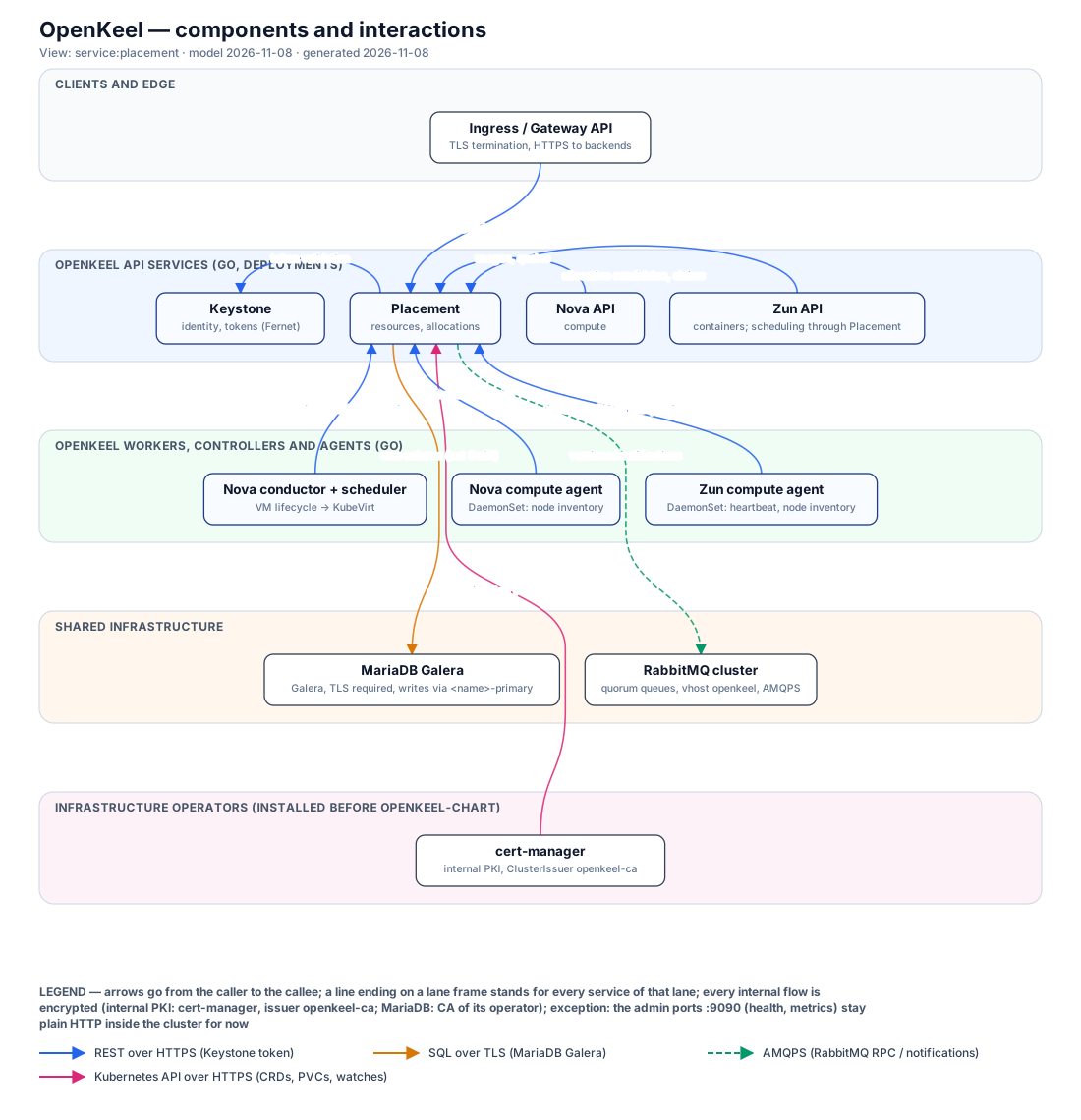
Resource inventories and allocations; the first component rewritten in Go.
Go MariaDB Galeraopenkeel-placement
The module
OpenKeel implementation in Go of OpenStack placement (placement-api), generated from the reverse-specification of branch stable/2026.2 by the generate-go-from-spec skill. It replaces the Python service without its clients noticing: same routes, status codes, error bodies, microversions and policies. What is reproduced and what differs is in docs/CONFORMANCE.md; the security checklist is in docs/SECURITY.md.
Go module: github.com/openkeel/openkeel-placement
Binary: placement-api (API on port 8778, health and metrics on 9090)
Configuration: YAML, see config/config.example.yaml
Setting up a development environment, the database and the tests: docs/GETTING-STARTED.md
Database schema, migrations and upgrades: docs/DATABASE.md
Excerpt from openkeel-placement/README.md (in English).
REST API
37 operations of the original REST API (routes and body actions), and their state in OpenKeel.
The recorded gabbi exchanges of Python Placement are replayed against the Go service, and Nova's own functional suite runs with the Go service in place of Python Placement.
Replay of recorded exchanges
E2E replay of the gabbi exchanges
Every request of the 79 upstream gabbi files gives the same status and body as the recorded Python service.
How it runs
make e2e, with E2E_MYSQL_DSN for MariaDB; report in test/e2e/report.json, differences listed in known-differences.txt.
Latest result 1303 / 1316 identical on MariaDB 11.4 (1301 / 1316 on go-mysql-server); none of the remaining differences is a functional bug.
Source: openkeel-placement/docs/CONFORMANCE.md
Unit and golden tests
Allocation-candidates algorithm cases
The allocation-candidates algorithm returns the same candidates as Python on 83 recorded cases, up to 6000 providers.
How it runs
go test -tags e2e -run TestAllocationCandidateCases ./test/e2e/; report in test/e2e/cases-report.json.
Latest result 81 / 83 identical, 83 / 83 on the number of candidates.
Source: openkeel-placement/docs/CONFORMANCE.md
Differential test
Nova functional tests against Go Placement
Nova's functional test suite passes when every Placement call is served by the Go service instead of Python Placement.
How it runs
Nova's functional tests run through test/nova-functional/run.sh, on go-mysql-server and MariaDB 11.4, compared with a Python Placement baseline.
Latest result Subset 859 / 859 on MariaDB 11.4 (as Python); full suite 3314 passed, 1 failed (an engine bug) on go-mysql-server (2026-10-28).
Concurrent allocations through three service instances on three Galera nodes never overallocate a resource provider.
How it runs
GALERA_DSNS=... go test -tags galera ./test/galera/ on a 3-node MariaDB Galera 11.4 cluster.
Latest result Pass: 180 concurrent allocations for 100 VCPU give exactly 100 allocations, 0 unexpected status.
Source: openkeel-placement/docs/CONFORMANCE.md
Tempest
Tempest with a real Placement
Tempest and Nova functional tests against a deployed Placement on a cluster.
How it runs
Needs a kind cluster (reverse-spec 07 § 7 step 5).
Latest result Not run.
Source: openkeel-placement/docs/CONFORMANCE.md
Left out of the rewrite
Placement keeps its whole API and leaves out only the unauthenticated test mode, legacy data migrations and the oslo service plumbing that Kubernetes already provides.
Internal machinery simplified
noauth2 unauthenticated mode
Why it was left out
An API without authentication has no place in production; the test suites inject a token validator instead.
Why the solution is not affected
Clients always authenticate through Keystone, as they do in any real deployment. Nova, Neutron and osc-placement are unaffected.
Source: openkeel-placement/docs/CONFORMANCE.md
Obsolete or unused upstream
Online data migrations for old databases
Why it was left out
set_root_provider_ids and create_incomplete_consumers only fix databases older than the reproduced branch.
Why the solution is not affected
A fresh or current database never needs them; databases older than the branch are refused instead of being migrated in place.
Source: openkeel-placement/docs/CONFORMANCE.md
Done by the Cloud Native platform
CORS middleware
Taken over by Ingress (Gateway API)
Why it was left out
Cross-origin headers are a concern of the HTTP edge, not of each API process.
Why the solution is not affected
No OpenKeel client calls Placement from a browser on another origin; where needed, CORS is configured once on the ingress.
Source: openkeel-placement/docs/CONFORMANCE.md
Done by the Cloud Native platform
File logging, osprofiler, healthcheck middleware
Taken over by Kubernetes probes, OpenTelemetry
Why it was left out
Logs go to stdout as JSON, traces to OpenTelemetry and health to Kubernetes probes; 101 of 108 oslo options became useless.
Why the solution is not affected
Operators get the same information through the cluster's log, tracing and probe tooling; the API is unchanged.