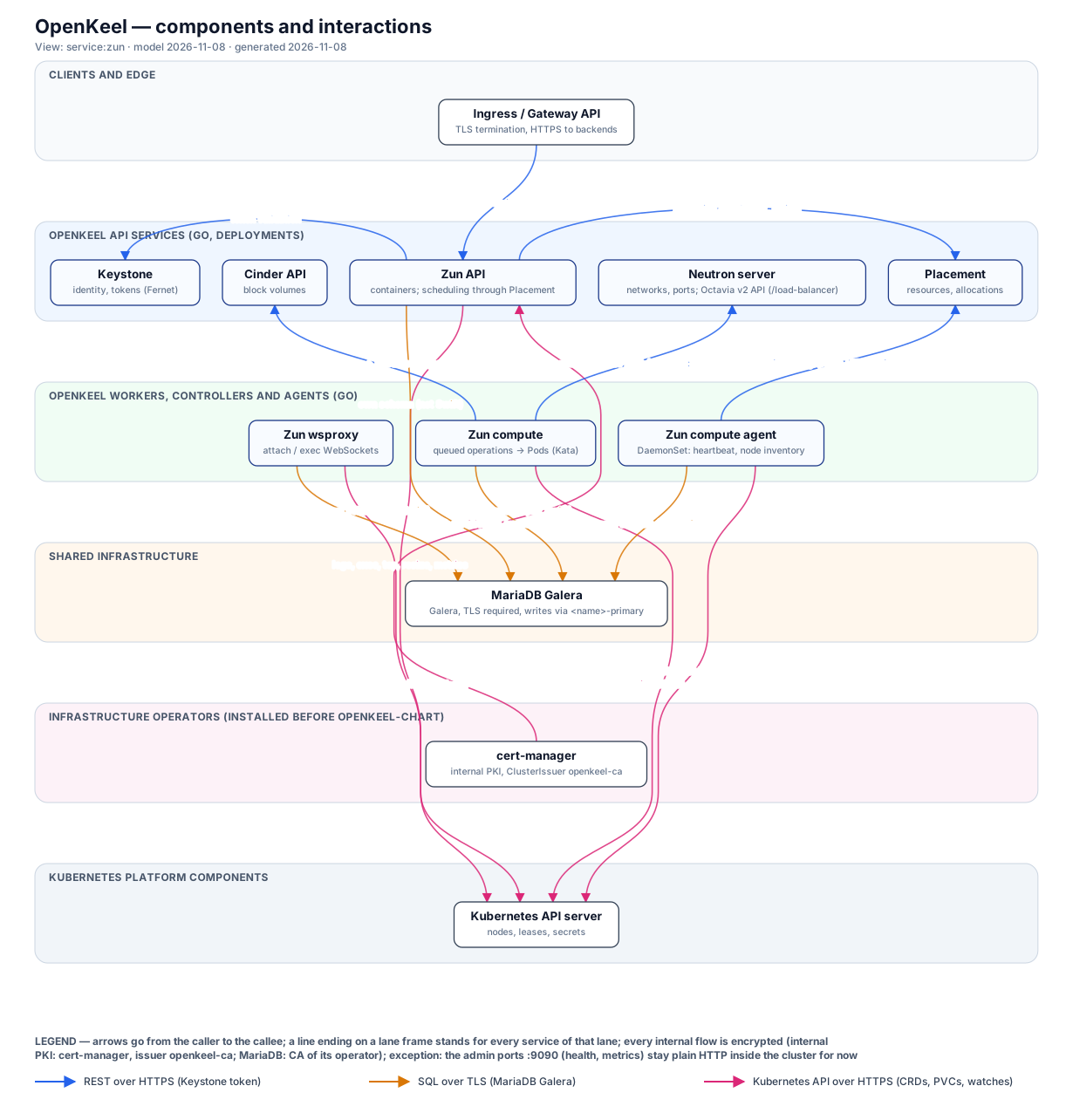
Containers as a Service: one Pod per container, isolated in its own Kata microVM, with its Neutron port as its only network.
Go Kata Podsopenkeel-zun
The module
OpenKeel implementation in Go of OpenStack Zun (containers service), generated from the reverse-specification of branch stable/2026.2 (reverse-spec-zun/) by the generate-go-from-spec skill. The Zun v1 API (microversions 1.1 to 1.40) is kept byte-compatible, so python-zunclient, openstack appcontainer, Skyline, Heat and gophercloud keep working unchanged. The node side is replaced: containers run as Kubernetes Pods, isolated in Kata Containers VMs by default, on the node that Placement chose, as openkeel-nova runs VMs on KubeVirt.
What is reproduced and what differs is in docs/CONFORMANCE.md and in § Compatibility gaps below; the security checklist is docs/SECURITY.md.
runs the queued operations: Neutron ports, Cinder attachments, Pods; state sync
the container work of zun-compute
zun-compute-agent
DaemonSet
zun-compute service heartbeat, compute_node row, Placement inventory of its node
the inventory and service parts of zun-compute
zun-wsproxy
Deployment (port 6784)
attach and interactive exec WebSockets
zun-wsproxy
zun-cni, zun-cni-daemon, Docker, containerd CRI and kuryr-libnetwork are gone. There is no RabbitMQ: the API queues each asynchronous operation in the openkeel_task table, which zun-compute claims by compare-and-set.
Configuration: YAML, see config/config.example.yaml (dropped oslo options and why: config/dropped-options.md)
Development environment, database and tests: docs/GETTING-STARTED.md
Database schema, migrations and upgrades: docs/DATABASE.md
Integration with openkeel-nova (one change to its agent): docs/NOVA-INTEGRATION.md
Excerpt from openkeel-zun/README.md (in English).
REST API
73 operations of the original REST API (routes and body actions), and their state in OpenKeel.
Exchanges recorded from Python Zun's API tests and probes of the real Pecan application are replayed against the Go service, with algorithm vectors and a controller test on a fake cluster.
Replay of recorded exchanges
E2E replay of recorded API tests
The 256 exchanges of 221 Python API tests give the same status and body, each on a database seeded as the recorded test implied.
How it runs
make e2e (test/e2e), report in report.json; make e2e-strict fails on any difference not listed in known-differences.txt.
Latest result 223 / 256 identical; strict mode passes, the 35 differences listed with their reason.
Source: openkeel-zun/docs/CONFORMANCE.md
Replay of recorded exchanges
Probes of the real Pecan application
Requests sent to the real Python application, outside its unit tests, get the same answers from the Go service.
How it runs
Replay of test/e2e/testdata/zun.probes.json in the e2e suite.
Latest result 30 / 32; the 2 others are Python defects fixed on purpose (traps T7, T13).
Source: openkeel-zun/docs/CONFORMANCE.md
Unit and golden tests
Algorithm vectors from Python
Image name parsing, pull decisions, Docker state mapping, Placement queries, restart policy and port rules match the Python functions.
How it runs
internal/zun/vectors_test.go on _rewrite/vectors_stable-2026.2.json.
Latest result 8 / 8 families, 307 cases.
Source: openkeel-zun/docs/CONFORMANCE.md
Unit and golden tests
Container lifecycle on a fake cluster
Create, schedule, claim, Neutron ports, Kata Pod, stop and delete leave the same records as Python, ports and allocations included.
How it runs
internal/compute/manager_test.go with Kubernetes fakes.
Latest result Pass.
Source: openkeel-zun/docs/CONFORMANCE.md
Left out of the rewrite
Zun keeps its v1 API but runs containers as Kubernetes Pods in Kata VMs, so Docker-specific operations and the Docker, CNI and Kuryr node stack are gone.
Done by the Cloud Native platform
Docker daemon, zun-cni and kuryr-libnetwork
Taken over by Kubernetes Pods, Kata Containers
Why it was left out
Containers are Pods placed by Placement and isolated in Kata VMs; Neutron ports attach through the OVN CNI, and the kubelet pulls images and mounts Cinder PVCs.
Why the solution is not affected
python-zunclient, openstack appcontainer, Skyline and Heat keep working against the same API; the node stack is the cluster's own.
Source: openkeel-zun/README.md
Done by the Cloud Native platform
Pause, unpause and commit
Taken over by Kubernetes
Why it was left out
Kubernetes has no freezer or commit API; adding them would need a node agent with root access to containerd or cgroups, which OpenKeel refuses (decision 2026-11-02).
Why the solution is not affected
These actions answer 409 container.operation-not-supported. Images are built in a registry; running containers are unaffected.
Source: openkeel-zun/docs/CONFORMANCE.md
Done by the Cloud Native platform
Writable layer kept across stop
Taken over by Kubernetes
Why it was left out
Kubernetes has no stopped Pod that can start again: stop deletes the Pod and start creates a new one.
Why the solution is not affected
The container filesystem and logs are lost on stop. Data kept in Cinder volumes survives stop, start, reboot and rebuild, which is the documented practice.
Source: openkeel-zun/README.md
Done by the Cloud Native platform
Docker image search, docker load, Docker networks
Taken over by Kubernetes (kubelet)
Why it was left out
There is no daemon to search, load archives or create networks; kubelets pull from registries and Pods attach Neutron ports directly.
Why the solution is not affected
Image search returns only exact references, Glance images need an OCI reference, and network create only records a row. Container networking itself is Neutron's.
Source: openkeel-zun/README.md
Done by the Cloud Native platform
DISK_GB claim in Placement
Taken over by Kubernetes (ephemeral-storage)
Why it was left out
No OpenKeel provider publishes DISK_GB, root disks being PVCs; the claim would put every container with a disk in Error.
Why the solution is not affected
The disk becomes the Pod's ephemeral-storage request and limit: the kubelet places and caps it, as Docker's storage-opt did. CPU and memory are still claimed in Placement.
Source: openkeel-zun/docs/CONFORMANCE.md
Internal machinery simplified
RabbitMQ RPC to zun-compute
Why it was left out
The API queues each asynchronous operation in a database table that zun-compute claims by compare-and-set; one active zun-compute holds a Lease.
Why the solution is not affected
No RabbitMQ is needed for Zun and the API is unchanged; a crashed worker's task is taken over.
Source: openkeel-zun/README.md
Only what was left out by design is listed here; the work not done yet is in the Known gaps of the module's docs/CONFORMANCE.md. Every module
Zun interactions
Service view generated by the diagram skill from the OpenKeel model.