Kubernetes
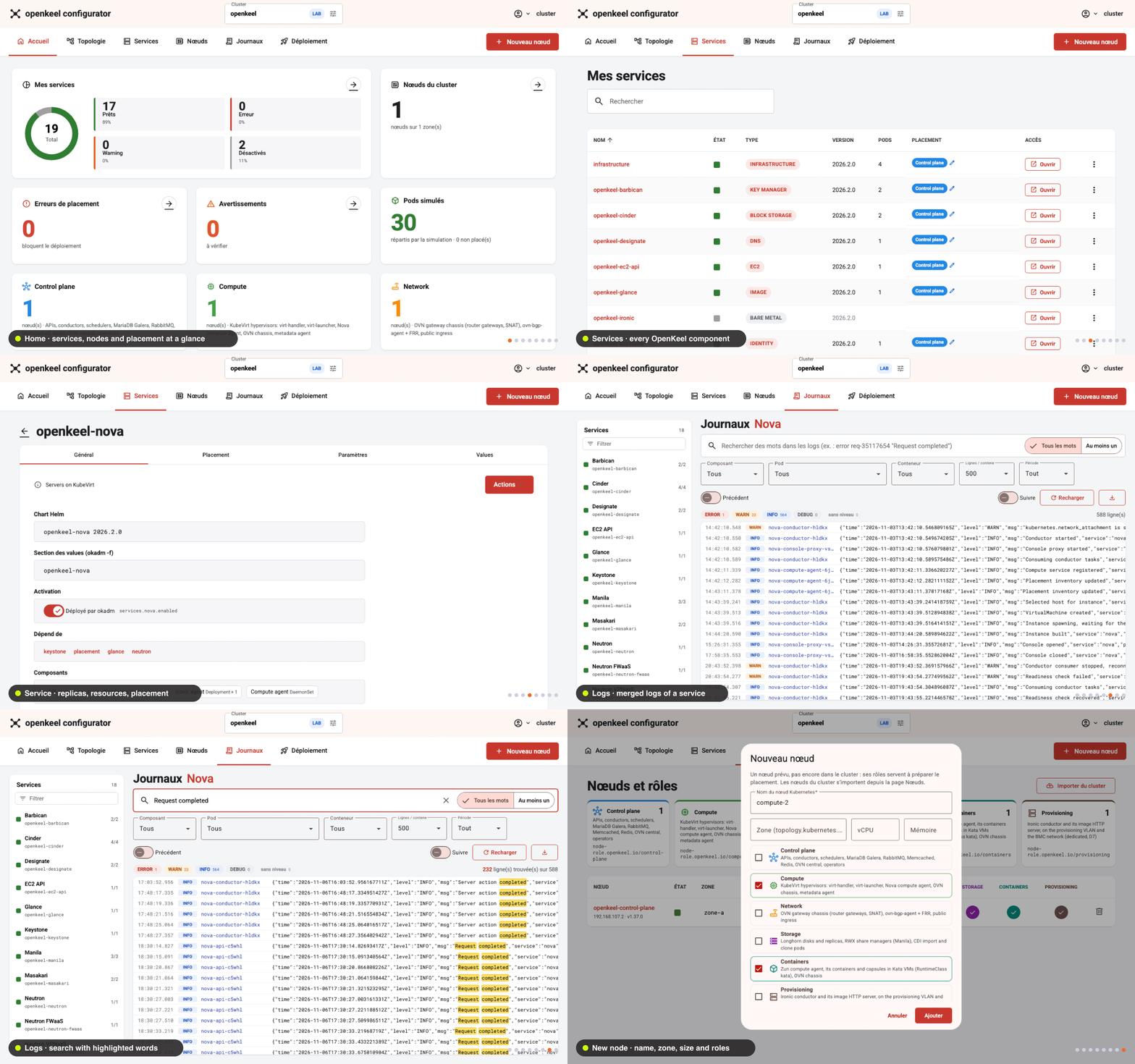
Each service is a Deployment or a DaemonSet; Kubernetes manages replicas, restarts, configuration and secrets.
Learn moreOpenKeel: the sovereign French Cloud solution of the inherent group, with a European reach Discover inherent
The sovereign French Cloud solution of the inherent group, with a European reach
OpenKeel builds a natively multi-tenant Cloud from Cloud Native, open source technologies and is itself open source under the Apache 2.0 license, designed to be SecNumCloud-ready. Its REST APIs are fully compatible with OpenStack's: the same modules, rewritten in Go, deploy on Kubernetes clusters, and a command line makes deployment and life-cycle management plug and play. OpenKeel is a Cloud designed in the AI era and for AI.
“A modern, sovereign Cloud and Cloud Native platform with a broad ecosystem”
OpenKeel is a solution of the inherent group, a French IT group expert in AI, cloud, cybersecurity and connectivity for businesses and public bodies (inherent.fr).
Built on open source software and open standards, OpenKeel gives organisations a Cloud they control: the code, the deployment and the data stay in their hands, on the infrastructure of their choice in France and in Europe.
OpenKeel keeps the contracts that give the OpenStack ecosystem its value (REST API, MariaDB data model, RabbitMQ messages) and replaces their Python implementation with Kubernetes-native Go services.
The data plane is not rewritten: it is handed to proven Cloud Native projects. Kubernetes orchestrates, KubeVirt runs the VMs, OVN carries the tenant networks, CSI provides the volumes.
OpenKeel rewrites the control plane and hands the data plane to proven Kubernetes building blocks.
Each service is a Deployment or a DaemonSet; Kubernetes manages replicas, restarts, configuration and secrets.
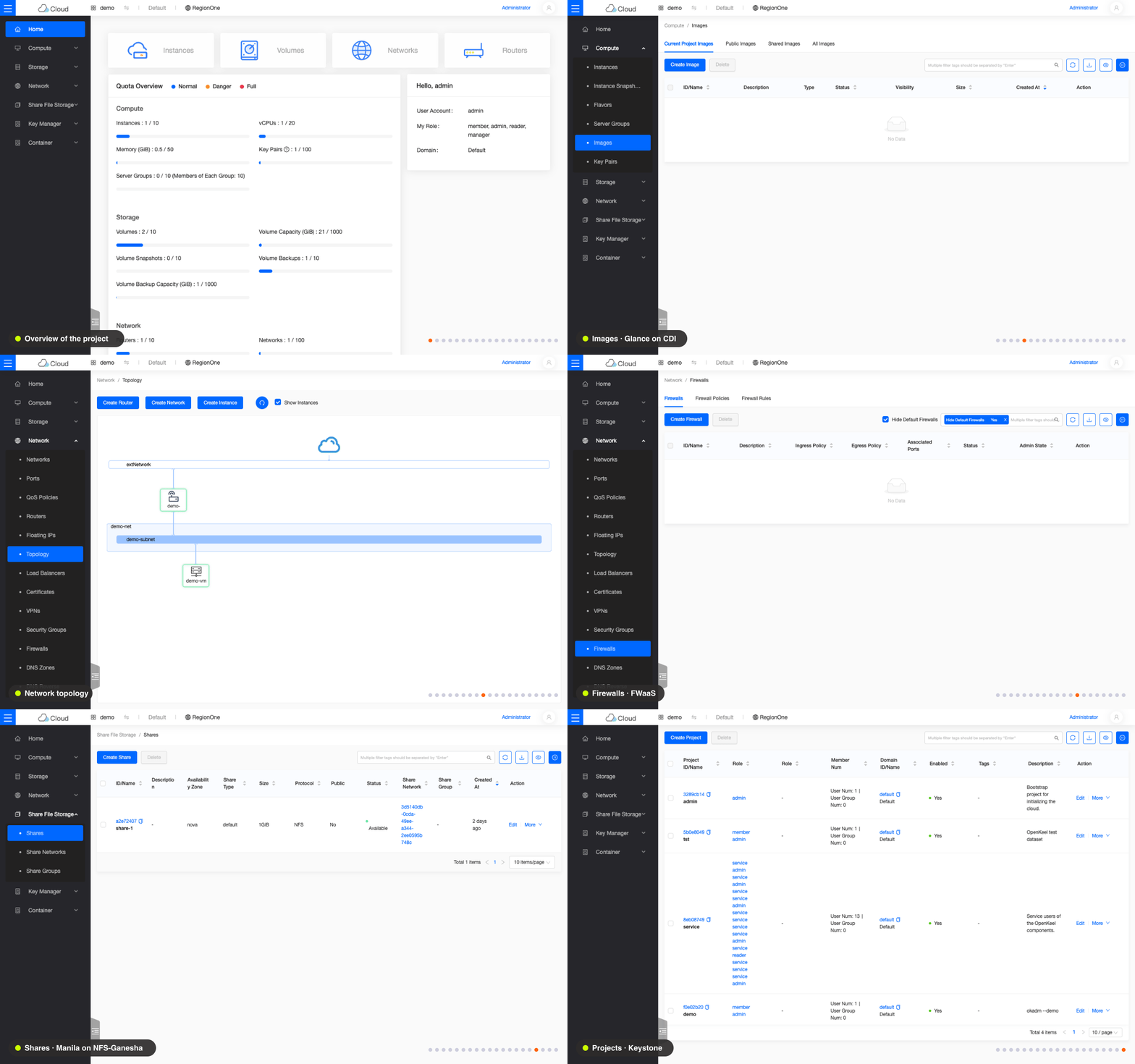
Learn moreNeutron writes networks, routers, ACLs and NAT to OVN Northbound; the VM network stays isolated from the Pod network.
Learn moreNova instances are VirtualMachines; CDI imports the Glance images into volumes.
Learn moreCinder volumes run on Rook-Ceph, Longhorn, NetApp, Huawei Dorado or our own Pure Storage driver; Manila shares go through NFS-Ganesha, S3 and Swift through Ceph RGW.
Learn moreZun runs each container in its own microVM: one kernel per container, its Neutron port as its only network.
Learn moreMasakari relies on Node Healthcheck and Self Node Remediation; Designate publishes through ExternalDNS.
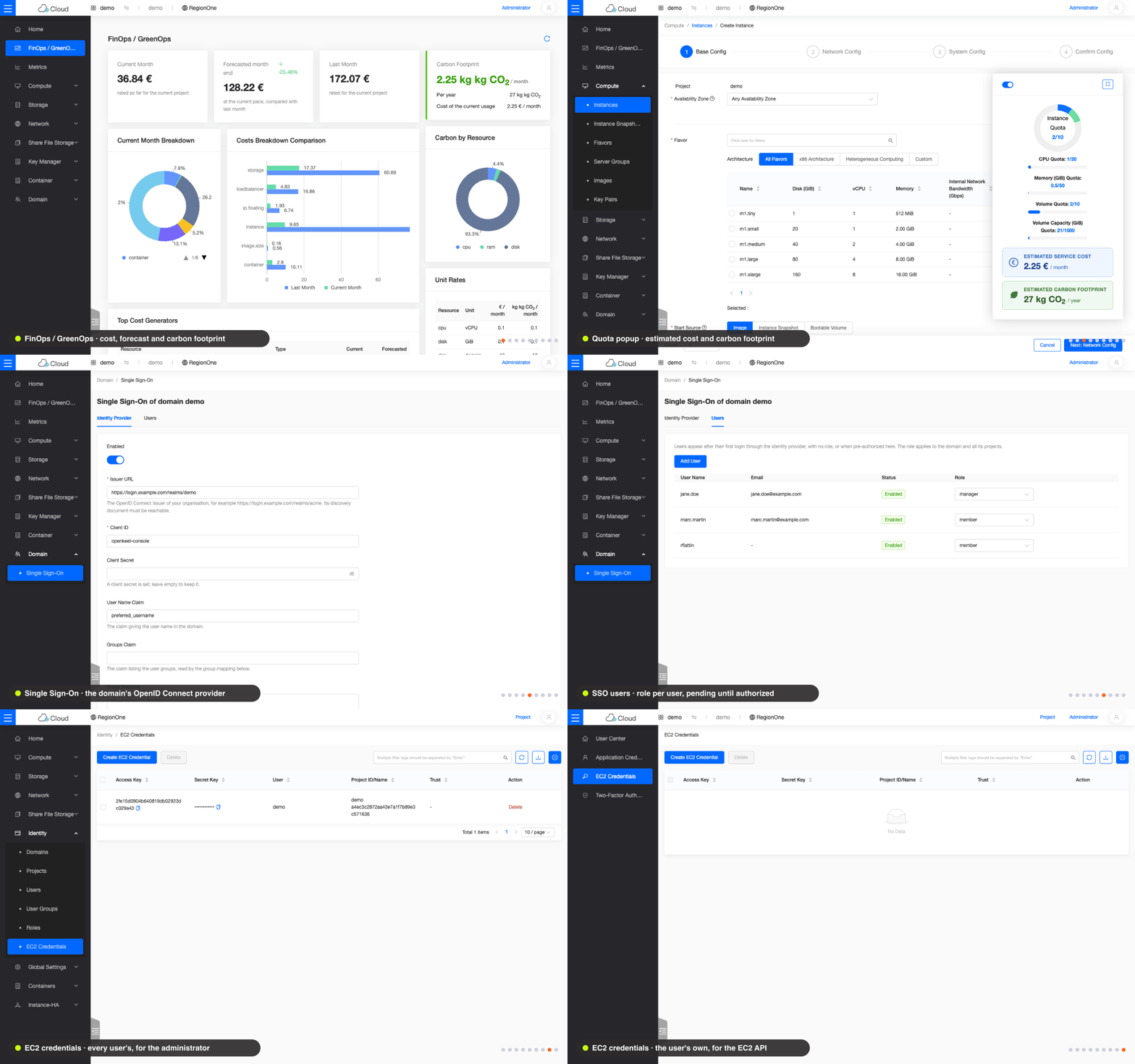
Learn moreThe Keystone model (domains, projects, roles, policies) splits the Cloud into tenants. Tenants have no access to Kubernetes: only the OpenKeel services create Pods, VMs and volumes.
Each VM NIC is plugged into its own Neutron port in OVN, with no interface on the Pod network; a CNI guard closes the paths to the node. Manila creates an NFS gateway inside the tenant network, and Zun isolates each container in a microVM.
SecNumCloud, the ANSSI qualification, applies to a service and its provider, not to a piece of software. OpenKeel is designed so that a provider can qualify a Cloud built on it: it puts no obstacle in the way of a technical requirement, and it supplies the mechanisms and the evidence the audit asks for.
Every requirement is tracked in the open: what is compliant today, what is in progress and what is left to evolve, each with its evidence in the code.
An OpenKeel component replaces the original without clients, SDKs, Terraform, Tempest or neighbouring services noticing.
The OpenStack services, specified from their upstream code then generated in Go, each with its reverse-spec, its diagram and its tests.
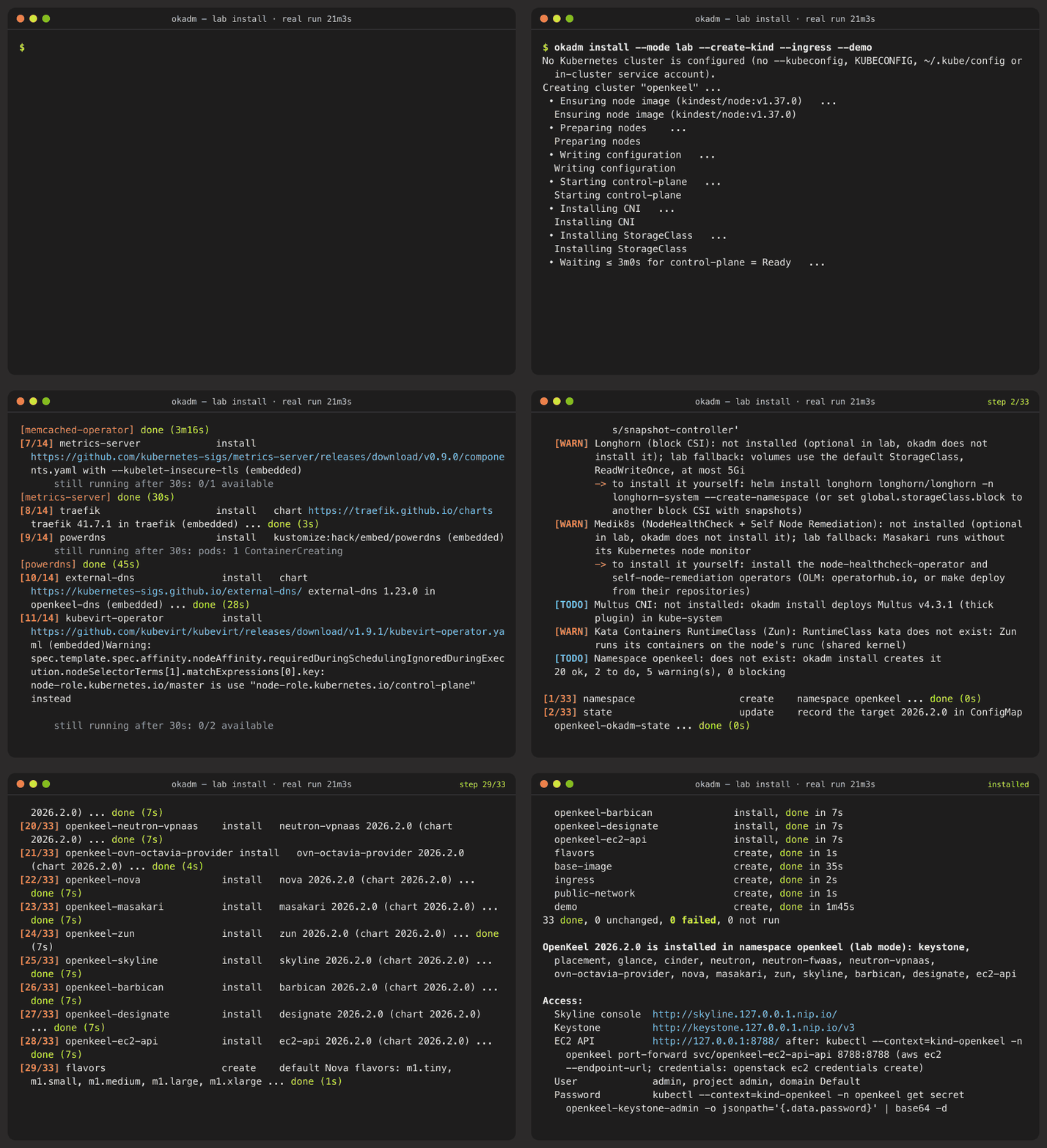
okadm is a Go binary that embeds client-go, the Helm SDK and the OpenKeel charts. It checks the cluster, installs the missing operators, then the data services and the components in dependency order, and resumes where it stopped.
okadm plan    --mode lab                                # does the cluster fit? what is missing?
okadm install --mode lab --create-kind --ingress --demo  # kind cluster, Traefik, Skyline, demo project
okadm status                                            # version, Helm releases, pod state
okadm upgrade --version 2026.2.1 # one component at a timeThe essential answers to understand OpenKeel.
The sovereign French Cloud solution of the inherent group, with a European reach. It rewrites the OpenStack services in Go on top of Cloud Native technologies (Kubernetes, OVN, KubeVirt, CSI). Its REST APIs are compatible with OpenStack's and it deploys on Kubernetes with the okadm CLI.
The inherent group, a French IT group expert in AI, cloud, cybersecurity and connectivity for businesses and public bodies.
The Apache License 2.0, the license of OpenStack: the code can be used, modified and redistributed, commercially too, with an explicit patent grant; the license and the copyright notices go with every copy, and changes are marked as such.
SecNumCloud (ANSSI) qualifies a service and its provider, not a piece of software. OpenKeel is designed to be SecNumCloud-ready: every internal flow in TLS, a CADF audit trail on every API, OpenStack RBAC, Barbican with an HSM, Kata isolation for containers, signed images with an SBOM on a controlled registry. What is compliant today and what is left to evolve, requirement by requirement, is on SecNumCloud-ready.
Yes: each component keeps the paths, parameters, HTTP codes, error bodies, microversions and policies of the original. Clients, SDKs, Terraform, Tempest and Skyline see no difference. Known gaps are listed in each module's docs/CONFORMANCE.md.
Endpoints, errors, interactions, scenarios and rewrite pack of each upstream repository.
BrowseOverview, platform, per service, per protocol and node placement.
See the viewsThe reference presentation of the project, as PowerPoint and PDF.
Download